
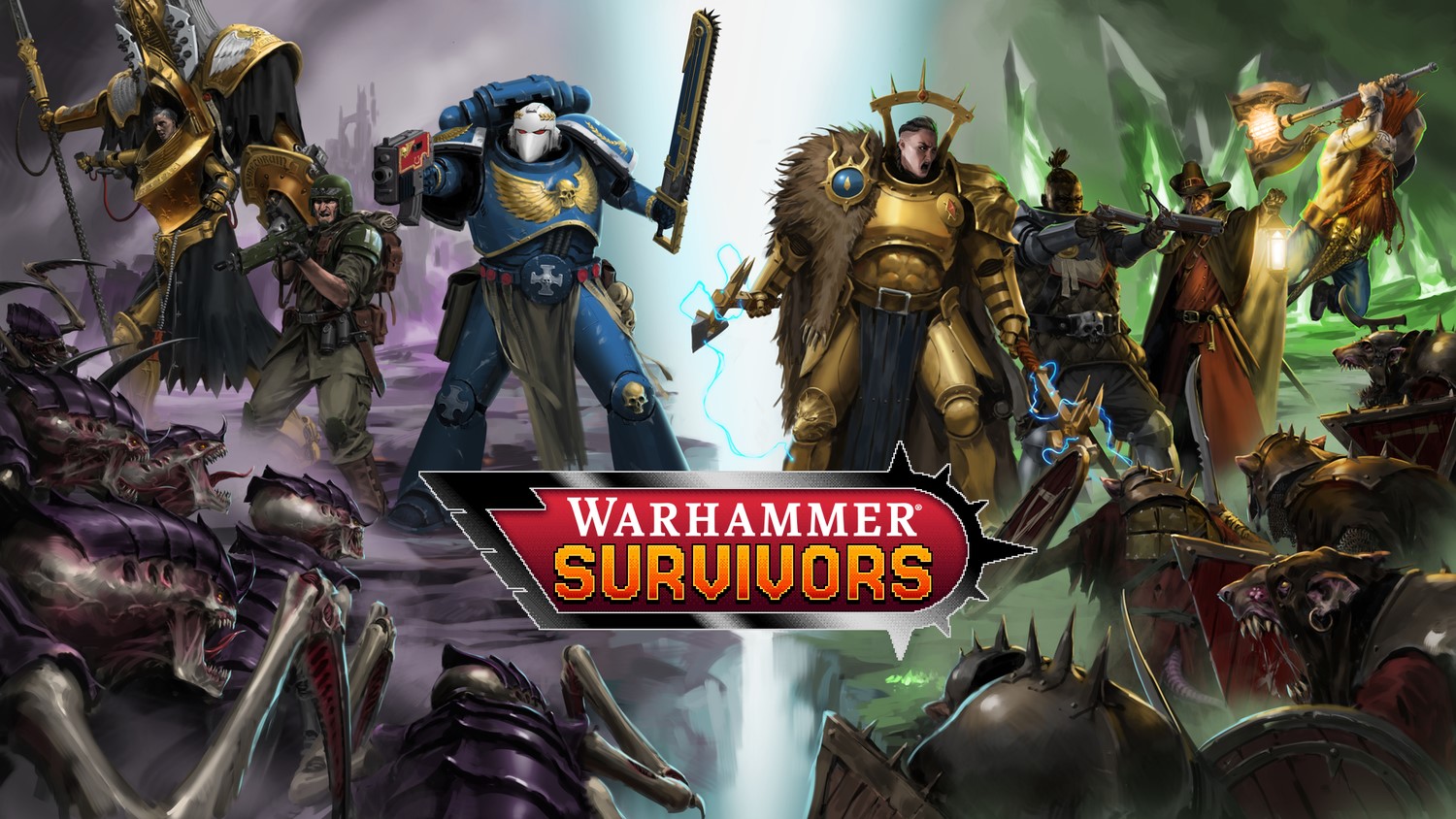


Warhammer Survivors arrived on November 10 with a wonderfully uncomplicated proposition: take two universes famous for endless warfare, fill the screen with enemies and see how long a handful of heroes can survive. It's the sort of idea that makes so much sense you wonder why nobody tried it sooner. The Imperium of Man has been fighting impossible odds for decades, after all. Giving its warriors a few thousand more enemies barely qualifies as a scheduling inconvenience.
Developed by Auroch Digital, the studio behind Warhammer 40,000: Boltgun, the game borrows the bullet-heaven formula popularized by Vampire Survivors. But its most interesting decision isn't the genre. It's bringing Warhammer 40,000 and Age of Sigmar together without forcing either setting to behave like the other.
Warhammer 40,000 and Age of Sigmar share a taste for enormous battles, but their worlds couldn't be more different. One offers chainswords, bolters and a galaxy permanently on the brink of catastrophe. The other features magical realms, monstrous creatures and warriors fighting in the name of gods who aren't particularly good at keeping the peace.
Warhammer Survivors turns those differences into a playable contrast. Players can fight Tyranids, Orks and the Death Guard in the 41st Millennium, then switch to the Mortal Realms to face Skaven, the Blades of Khorne and the Gloomspite Gitz. The latter bring Squigs and towering Troggoths into the mix, ensuring that even the smallest enemies can arrive with something considerably larger behind them.
The two settings also give the developers room to experiment with weapons and abilities. A futuristic firearm and a magical relic don't need to behave alike, which should help prevent the enormous roster from becoming a collection of interchangeable characters.
Auroch Digital promises more than 40 playable champions and over 70 weapons. Familiar faces include Malum Caedo from Boltgun, Morvenn Vahl of the Adepta Sororitas and Lyssa Revenya, a thief whose equipment is rather less conventional than a Space Marine's arsenal.
Lyssa's Rope and Grapnel attacks enemies from the edges of the battlefield, while its evolved form summons the vengeful Ghost of Rhea. It's a good example of how the game can translate established character identities into unusual combat mechanics instead of simply handing everyone a different-colored projectile.
Of course, a large roster is only valuable if its members feel distinct. Survivors games depend on repeated runs, and players need meaningful reasons to experiment with new combinations. Forty characters who all solve problems by filling the screen with slightly different explosions would be less impressive than ten with genuinely different playstyles.
One mechanic gives Warhammer Survivors a chance to stand apart from its inspiration. Characters, weapons and certain items carry keywords that determine which equipment a champion can use directly. Choosing a weapon outside those restrictions can bring an AI-controlled follower into the fight instead.
That creates an interesting choice. Players can concentrate on equipment suited to their hero or recruit additional firepower through companions. It also fits Warhammer rather neatly, since the tabletop games have always emphasized armies built around particular factions, roles and battlefield combinations.
The danger is that managing keywords could become more distracting than entertaining. Bullet-heaven games work because decisions are quick and the action rarely stops for long. If the squad system adds clever combinations without turning every upgrade into a rules consultation, it could become the feature that gives this spin-off its own identity.
The October demo introduced the Legend of Catachan and Lyssa Revenya alongside additional weapons and improvements based on earlier feedback. Players could experience both settings before the full launch, while the developers continued adjusting the balance and general usability.
That matters because the opening minutes are rarely the hardest part of designing a survivors game. The real problems emerge when the battlefield fills with enemies, attacks overlap and players have assembled combinations powerful enough to make the screen resemble a malfunctioning fireworks factory.
Auroch Digital has experience turning Warhammer's exaggerated violence into enjoyable action through Boltgun. The challenge here is different: keeping repeated runs interesting after the novelty of watching hundreds of enemies explode has worn off.
Warhammer Survivors launches across PC, consoles and mobile devices, making it unusually accessible for a Warhammer action game. Its partnership with poncle, the creator of Vampire Survivors, also gives the project a direct connection to the genre's biggest success.
That pedigree is encouraging, but it creates expectations. The game needs more than familiar characters and an impressive enemy count. Satisfying progression, varied builds and interesting decisions will determine whether players return after their first successful run.
Warhammer has never struggled to invent reasons for its characters to fight. Warhammer Survivors must accomplish something trickier: make those battles worth repeating even after the player has already saved the day, died horribly and started all over again.

Kommentare
Füllen Sie das obige Formular aus, um einen Kommentar zu hinterlassen