
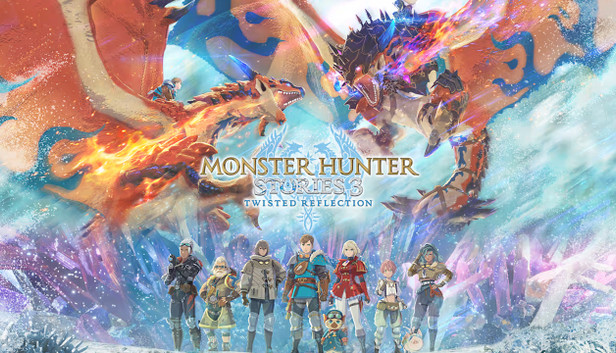


Monster Hunter Stories has historically served as the colorful, carefree younger sibling to Capcom’s flagship action series. That dynamic is officially changing. With Monster Hunter Stories 3: Twisted Reflection launching on March 13 across PC, PlayStation 5, Xbox Series X/S, and the Nintendo Switch 2, new gameplay details reveal a sequel that dramatically ages up both its narrative and its mechanics. Recent previews and developer blogs detail a grounded story rooted in political instability, alongside a massive new "Habitat Restoration" system that fundamentally rewrites the creature-collecting loop. For franchise veterans, the message is clear: the training wheels are off.
The most significant mechanical addition revealed in recent coverage is Habitat Restoration, a feature that turns players from mere poachers into ecological engineers. In previous games, the loop was simple: raid a den, steal an egg, and hatch a monster. Now, players are tasked with defeating feral monsters to establish campsites and subsequently releasing their captured Monsties back into the wild to repopulate these areas.
What makes this system genuinely compelling is how it alters the breeding meta. According to recent gameplay guides, heavily populating a habitat increases the drop rate of rare eggs containing superior skills. Even more fascinating is the mutation mechanic. By introducing alien monster species into a specific local habitat, players can force elemental variations and mutations, effectively creating bespoke hybrid beasts to bolster their party stats. It is a massive evolution of the traditional gacha-style egg hunting, giving players direct, tangible control over the environment and the rewards it yields.
Capcom has also addressed the most notorious friction point of the Stories franchise: gene harvesting. In the past, optimizing a monster’s 3x3 Bingo gene board meant permanently sacrificing the donor creature. Recent previews confirm that Twisted Reflection abandons this penalty entirely. Players can now extract genes without destroying the Monstie, allowing them to subsequently release that same creature to aid in Habitat Restoration. Furthermore, gene positions can be swapped at any time. This drastically lowers the barrier to entry for high-level competitive builds, respecting the player's time and encouraging experimentation rather than punishing it.
Combat is seeing a similar glow-up. While the traditional Power-Technical-Speed rock-paper-scissors triangle returns, the focus has shifted heavily toward part-breaking and the new Wyvernheart Gauge. Targeting specific monster parts with the correct weapon type depletes this gauge, eventually triggering a massive topple state. It brings the tactile, localized damage of the mainline action games directly into the turn-based arena.
With a hefty 50 GB footprint, Twisted Reflection is a massive RPG, and the global launch timings confirmed by Capcom reflect a staggered rollout. Console players on PS5, Xbox Series X/S, and Switch 2 will gain access at midnight local time, while PC hunters on Steam will need to wait until 4 AM GMT.
Ultimately, the previews paint a picture of a sequel that knows exactly what it wants to be. By combining a mature narrative with incredibly deep ecological systems and forgiving customization, Monster Hunter Stories 3: Twisted Reflection is shaping up to be far more than just a spin-off. It looks like a definitive RPG experience that might just eclipse the mainline series in sheer mechanical depth, setting a high bar for what fans should expect from Capcom moving forward.



Comments
Fill out the form above to leave a comment