
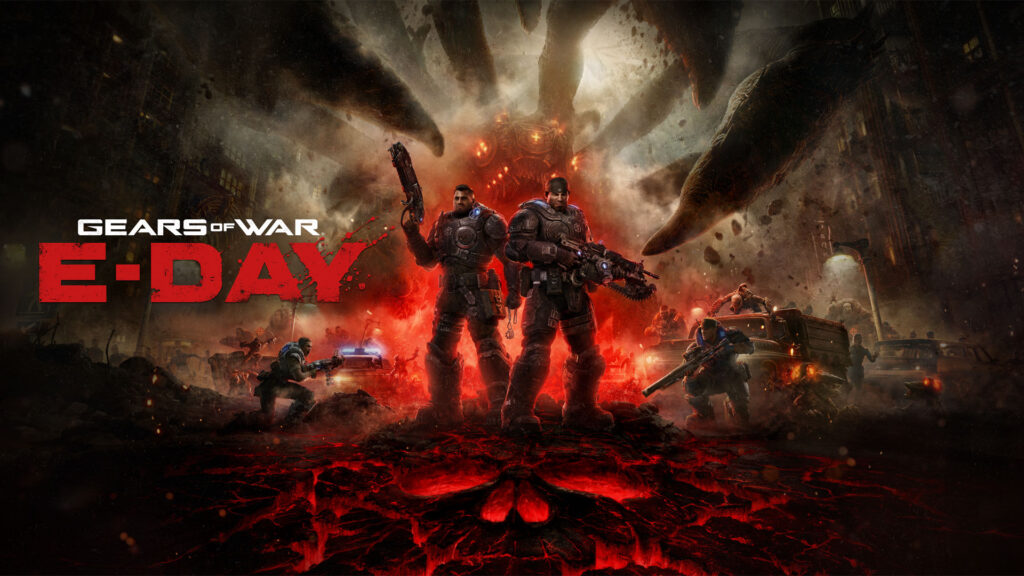


After twenty years of Gears of War, being frightened of the Locust takes some effort. We know what they look like, how they fight and, most importantly, roughly how much ammunition should be applied to the problem. A Drone appears, Marcus finds cover, somebody revs a Lancer, and another productive day at the COG begins. Familiarity is useful for players, but considerably less useful when you're trying to make monsters scary.
Gears of War: E-Day, launching today, October 6, gets around that problem by returning to the one moment when nobody on Sera knew the rules. This is the beginning of the Locust War, with creatures suddenly emerging beneath cities while soldiers scramble to understand what they're fighting. Marcus Fenix and Dom Santiago are already experienced soldiers, but experience doesn't help much when the ground has started producing armed monsters.
At its best, E-Day uses that confusion to make Gears feel surprisingly close to horror again. It doesn't maintain that tension perfectly: the campaign has uneven stretches, some new ideas work better than others, and player reaction has been noticeably more divided than the broadly positive critical reception. Still, when E-Day concentrates on the catastrophe itself, it makes an enemy we've spent decades killing feel dangerous again.
The trick is relatively simple. E-Day can't erase what players know about the Locust, so it focuses on characters who haven't learned any of it yet. When the invasion begins in Kalona, these aren't familiar enemies arriving for another round of cover-based combat. They're an unknown species appearing inside a city that was functioning normally until its streets suddenly became entrances to an underground army.
That perspective changes familiar encounters. Civilians panic, military responses fail and defensive plans become obsolete almost as quickly as people invent them. The COG hasn't yet developed years of experience fighting this war, so even Marcus spends much of the campaign reacting rather than confidently executing some established anti-Locust procedure. Considering the man is built approximately like a refrigerator that joined the military, making him look underprepared is an achievement in itself.
Kalona does much of the heavy lifting. The city deteriorates as Marcus and Dom move through it, with collapsing structures and increasingly devastated streets turning the environment into evidence of how quickly humanity is losing control. Unreal Engine 5 makes the destruction impressive to watch, but spectacle isn't the only point. E-Day works because the destruction feels like something happening to a place rather than scenery conveniently arranged around the next firefight.
The combat benefits from the same approach. Locust are most convincing when fighting one feels less like clearing another target from an arena and more like trying to remove an extremely angry piece of industrial equipment from your immediate surroundings.
E-Day retains the familiar cover-based foundation while giving players more ways to move through encounters. Arenas offer greater verticality, traversal has been expanded, prone provides another tactical option, and fights can encourage changing positions instead of permanently marrying the first chest-high wall available. The changes aren't revolutionary, but they give a familiar combat system enough flexibility to avoid feeling like The Coalition simply reopened a design document from 2006.
When everything comes together, the old rhythm remains excellent. Weapons have weight, Locust can absorb enough punishment to stay threatening, and close-range combat is still gloriously unpleasant. The Lancer chainsaw remains one of gaming's least subtle solutions to ammunition conservation, which is exactly how it should be.
Not every addition works equally well. Some new enemies cross the line from threatening into annoying, while larger spaces occasionally dilute the pressure instead of increasing it. More freedom is useful during a firefight, but E-Day sometimes discovers the obvious downside of giving players more places to wander: occasionally they wander away from the interesting part.
That uneven pacing explains some of the gap between strong reviews and a more complicated response from players. The complaints shouldn't be reduced to people simply resisting change. There are technical and performance concerns, disagreements over some mechanical changes and criticism of exploratory sections that can interrupt the momentum of a campaign supposedly unfolding during one of the worst days in human history.
There is also a separate wave of review bombing built around accusations that E-Day is “woke.” That noise makes the overall user response harder to read, but it shouldn't be mixed together with criticism of performance, pacing or design. Those are legitimate questions about the game itself, and E-Day gives players enough rough edges to discuss without importing an entirely different culture war into every firefight.
The strange thing is that its strongest sections actually make these problems more obvious. When Kalona is collapsing and Locust are pouring into places that felt safe minutes earlier, the campaign has tremendous momentum. Slower exploration can work as contrast, but when those sections stretch too far, the apocalypse starts feeling oddly patient. Apparently even Emergence Day occasionally waits for Marcus to finish looking around.
We already know the broad outcome. Marcus and Dom survive, the Locust War continues and humanity eventually becomes remarkably efficient at solving underground monster problems with assault rifles and industrial cutting equipment. E-Day therefore can't rely on the usual prequel question of what happens next.
Instead, it asks what this familiar universe looked like before everyone understood it. That turns recognisable enemies back into an invasion and experienced heroes into soldiers improvising their way through a catastrophe. The Locust haven't changed dramatically; the context around them has.
That is also why E-Day's weaker moments are frustrating rather than disastrous. The central idea works. The campaign simply doesn't maintain it with equal confidence everywhere, and the divided player reaction shows that returning to Marcus, Dom and classic Gears combat was never going to guarantee universal approval.
For most of the past twenty years, seeing a Locust has meant knowing exactly what weapon to reach for and which piece of cover to occupy. E-Day returns to the much more interesting moment before that knowledge existed, when humanity looked at the first monsters climbing out of the ground and had no idea what the correct procedure was. Marcus eventually finds the answer, of course. It involves considerably more ammunition than anyone would have preferred.
Komentarze
Wypełnij powyższy formularz, aby zostawić komentarz