
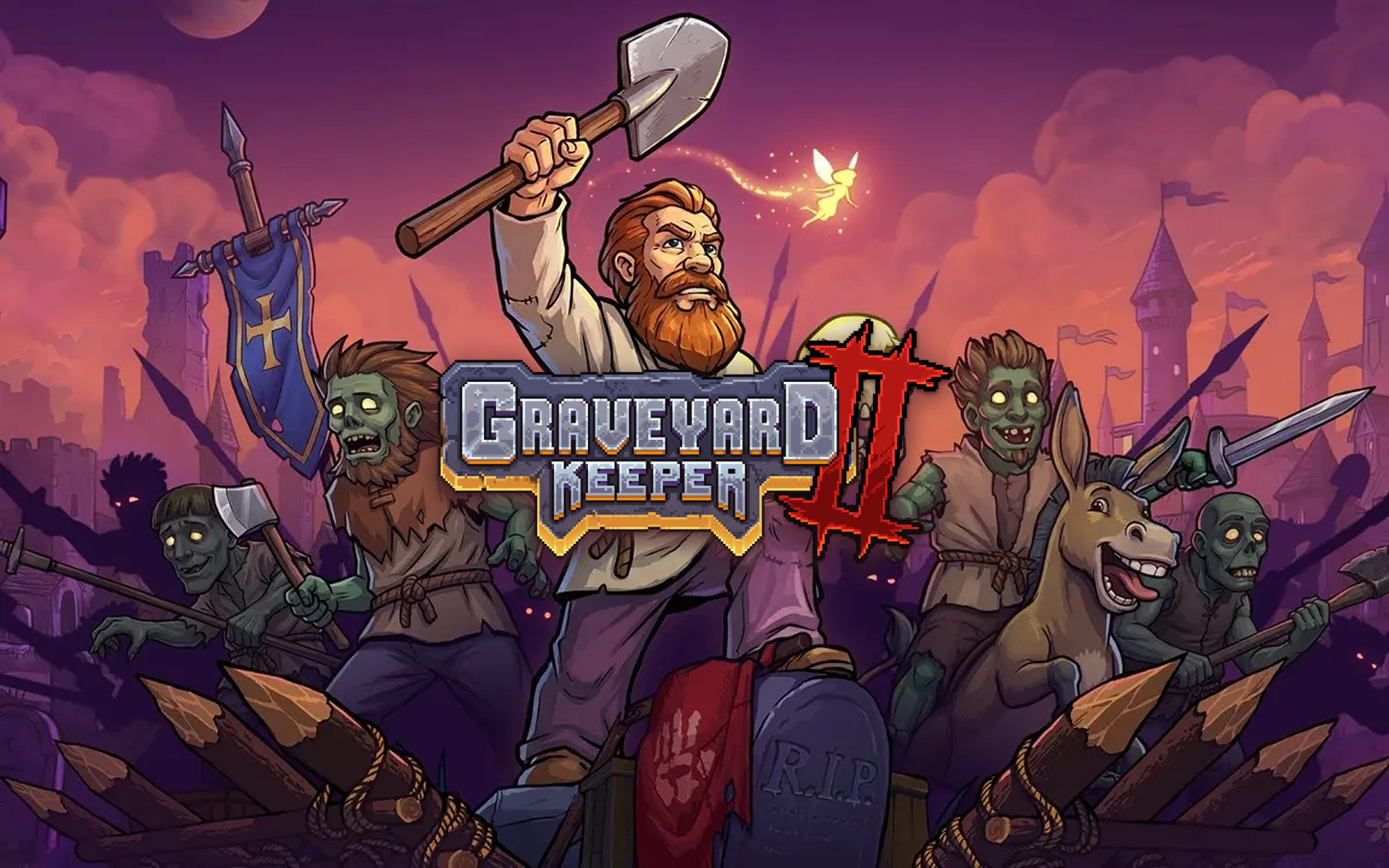


The original Graveyard Keeper gave you a cemetery and somehow turned burying corpses into one of gaming's most complicated small businesses. There were bodies to process, graves to improve, crops to grow, resources to collect and increasingly questionable ways to make money. Eventually, you could even put zombies to work because apparently labor laws become surprisingly flexible once the employees are already dead.
Graveyard Keeper 2, launching today, September 22, looks at all of that and reaches the only logical conclusion: one cemetery clearly wasn't enough.
This time there's an entire ruined town to manage, production chains to automate, fortifications to construct and an army of undead workers to organize. There's also a zombie apocalypse, which is slightly inconvenient when zombies are an important part of your business model.
Graveyard Keeper was always much larger than its title suggested. Running the cemetery quickly became an excuse to craft, farm, cook, trade, explore and become involved in the lives of people who probably should have asked more questions about what the local undertaker was doing after dark.
The sequel expands that philosophy from a cemetery to a whole settlement. The town has fallen into ruin, its inhabitants need help, and restoring it becomes another major responsibility for the Keeper. Naturally, helping people doesn't mean becoming charitable. Their problems are also opportunities, and a successful graveyard entrepreneur knows better than to waste a perfectly good revenue stream.
That changes the scale of the fantasy. You're no longer simply the suspicious person running the cemetery outside town. You're increasingly responsible for making the entire place function.
Fortunately, Graveyard Keeper 2 has discovered the greatest productivity hack in medieval history: workers who don't sleep.
Zombies can automate production and handle repetitive jobs, allowing resources to keep moving while the player concentrates on more complicated tasks. It's an evolution of one of the original game's smartest ideas, especially because Graveyard Keeper has never been shy about giving players an absurd number of chores. There is, however, a minor flaw in the undead workforce strategy. The world is also experiencing a zombie apocalypse.
That creates a wonderfully Graveyard Keeper situation. Some zombies are valuable employees keeping your economy alive. Other zombies are trying to destroy the town. Apparently the difference between economic infrastructure and existential threat is whether the corpse happens to be on your payroll.
This is where the sequel makes its strangest expansion. Graveyard Keeper 2 introduces defensive systems that push the series toward territory normally associated with strategy and tower-defense games.
Players can construct towers and fortifications, produce weapons and armor and build an army capable of dealing with incoming undead. The Keeper has therefore undergone quite a career progression: cemetery manager, farmer, craftsman, entrepreneur, zombie supervisor and now military commander.
On paper, it sounds like the sort of feature list produced when someone forgets to tell the developers to stop adding systems. In practice, it makes sense for a series whose identity has always depended on one task unexpectedly leading to five more. The first game turned maintaining a few graves into an enormous web of interconnected jobs. The sequel simply applies that philosophy to an entire town.
Of course, expansion comes with a danger. Graveyard Keeper has never been a particularly relaxing interpretation of the cozy management formula. Its pleasure comes from gradually untangling complicated production chains, learning which resources lead to which upgrades and eventually automating work that previously consumed half the day.
Adding a town, larger production systems and defensive mechanics means there are even more plates to keep spinning. Early reviews suggest that abundance can be both the attraction and the problem. There is almost always something useful to do, but managing everything can occasionally feel suspiciously close to acquiring a second job.
At least most jobs don't let you solve an employee shortage by raising the dead.
Calling Graveyard Keeper a dark Stardew Valley has always been useful shorthand, but Graveyard Keeper 2 shows how far the series has travelled from that comparison. Its cozy-game foundations are still visible in the crafting, relationships, gradual upgrades and satisfaction of watching an inefficient operation become increasingly organized.
The difference is what you're organizing. Graveyard Keeper 2 asks you to rebuild a town, exploit an undead workforce, establish automated production, construct defenses and survive hordes of zombies while continuing to run a respectable cemetery business on the side.
The game launches today, September 22, with more than $3 million already earned through Steam pre-orders. Maybe that shouldn't be surprising. The first Graveyard Keeper proved there was money in the dead. Graveyard Keeper 2 has simply scaled up the business.


Opmerkingen
Vul bovenstaand formulier in om een reactie achter te laten