
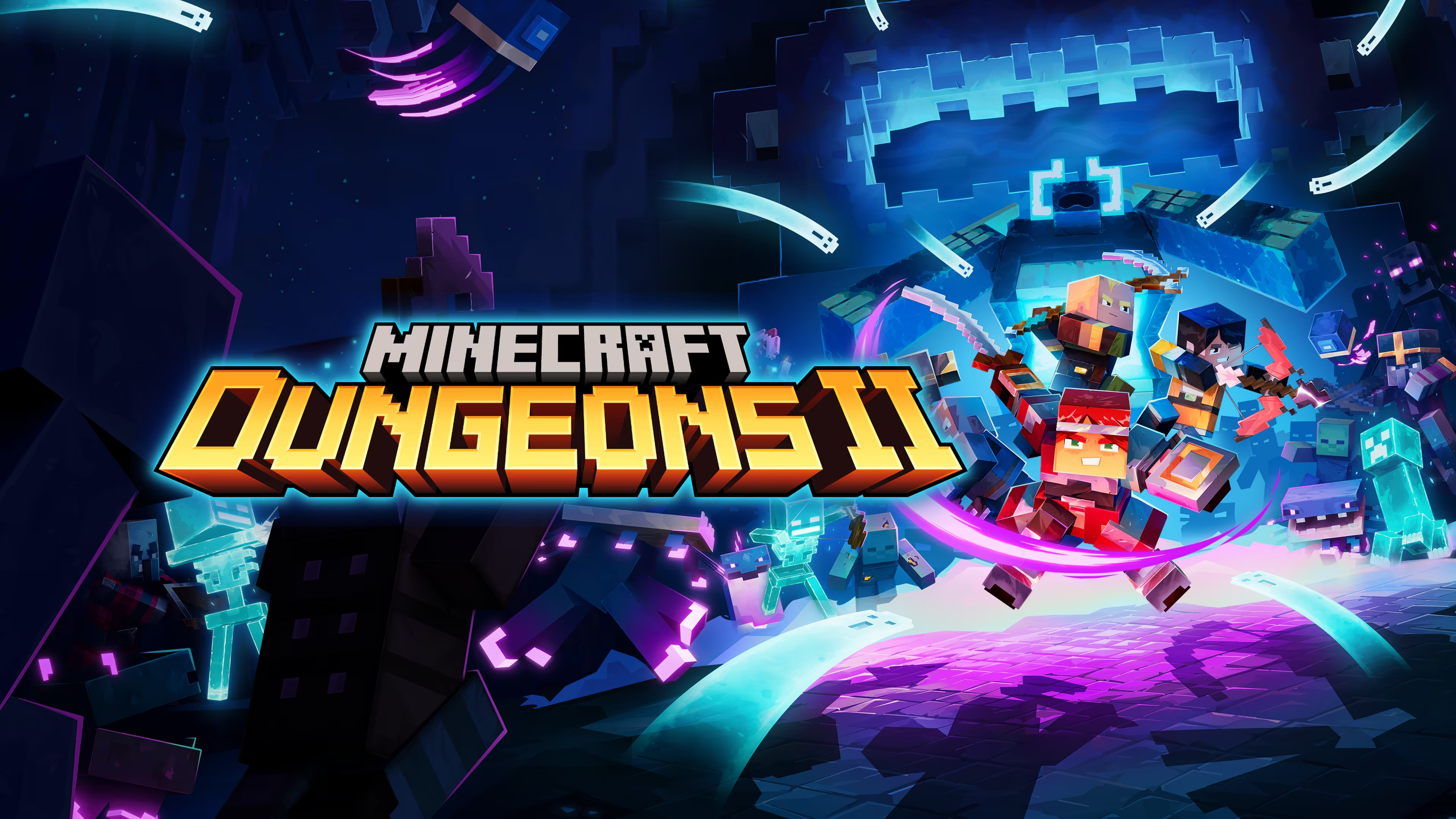


The original Minecraft Dungeons might have one of the easiest elevator pitches in gaming history: Minecraft meets Diablo. Take the blocks, Creepers and skeletons everyone recognizes, replace mining with dungeon crawling, add mountains of loot and let four friends argue over who wandered away from the group again. Explanation complete.
Minecraft Dungeons II, launching tomorrow, September 29, makes that description considerably less useful. Combat and loot are still at its centre, but the sequel expands exploration, connects its world more closely, introduces quests and new traversal mechanics, and even creates parts of the Minecraft universe that didn't previously exist. Six years later, Dungeons seems ready to become something more than the spin-off that borrowed another game's homework and covered it in cubes.
The first Dungeons was built around relatively self-contained adventures. Players chose a mission, entered an area, murdered an impressive percentage of the local monster population and returned with enough equipment to reconsider their entire build.
Dungeons II gives those adventures more connective tissue. Its environments are larger and more interconnected, with additional routes, quests and places worth revisiting. Jumping expands how those spaces can be designed, while exploration plays a much larger role in deciding what players encounter along the way.
That doesn't suddenly turn Dungeons into an open-world RPG, which is probably fortunate for everyone with a limited amount of free time. Instead, it makes the journey between battles more important. The original often treated environments as attractive routes toward the next fight; the sequel wants players to care more about what exists around those routes.
The Sift is perhaps the clearest sign of how the spin-off's role has changed. Rather than borrowing another familiar biome from Minecraft, Dungeons II introduces an entirely new dimension with its own environments, creatures and hazards. Players reach it through rifts and have to deal with conditions its inhabitants consider perfectly normal, despite those conditions being considerably less friendly to visitors.
More importantly, The Sift won't remain exclusive to Dungeons II. Mojang plans to bring the dimension to Minecraft in 2027. That reverses the relationship between the two games in an interesting way: instead of Dungeons simply taking blocks, mobs and locations from its much larger sibling, the main Minecraft is preparing to adopt something introduced by the spin-off.
Dungeons II has effectively been given permission to add to Minecraft rather than merely remix it. That's a much healthier identity for a sequel than spending another six years searching the original game's cupboards for unused Creepers.
The broader progression systems follow the same philosophy. Equipment and builds remain fundamental, but quests, expanded exploration and more varied encounters give players additional reasons to engage with the world. Full crossplay is available at launch too, which matters for a game designed around groups repeatedly discovering that coordinating four heroes is considerably harder than defeating a boss.
The sequel is also comfortable taking Minecraft into settings that don't fit the original Dungeons template quite as neatly. Battle for Tokyo is an especially obvious example, throwing the blocky action into a very different environment while keeping the familiar combat underneath. Dungeons is becoming a branch of Minecraft that can experiment without needing every idea to fit naturally into the sandbox.
That's useful because Minecraft itself carries enormous expectations. Changing a fifteen-year-old sandbox played by millions is complicated. A dungeon crawler can afford to be stranger, faster and more specific, then see which ideas are worth carrying elsewhere.
None of this means Dungeons II has abandoned what made the first game work. Players will still fight crowds of enemies, chase better equipment and spend unreasonable amounts of time comparing two weapons that appear almost identical until one number turns green.
The difference is that those systems no longer have to carry the entire identity of the game. Exploration matters more, the world is less fragmented, and original concepts like The Sift show that Dungeons can contribute something to Minecraft rather than simply borrowing its visual language.
Calling the first game “Minecraft Diablo” was useful because it explained almost everything in two words. Applying the same label to Dungeons II now requires enough footnotes that the description starts losing its purpose. That's probably a good problem for a sequel to have. Minecraft Dungeons II still knows exactly what kind of game it started as; it just finally seems confident enough to find out what else it can become.
Commentaire
Remplissez le formulaire ci-dessus pour laisser un commentaire