
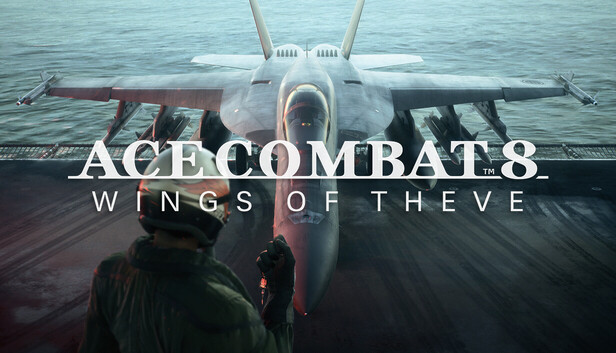


Ace Combat has always been very good at turning an anonymous pilot into a minor deity of aerial warfare. You begin as another callsign on the radio. Several missions later, enemy pilots are discussing your arrival with the enthusiasm normally reserved for natural disasters, while your own side starts treating one fighter jet as a perfectly reasonable solution to an entire military campaign.
Ace Combat 8: Wings of Theve, launching tomorrow, October 2, plays with that fantasy in a clever way. This time, the legend exists before the player earns it.
The FCU is losing its war against the Republic of Sotoa, and the occupied country desperately needs a hero. It gets one in the form of the Wings of Theve, a celebrated ace who becomes a symbol of resistance. The problem is that the legend surrounding Jan Cope isn't quite what people believe. After his death, the player secretly inherits that identity and is sent into the sky to make the propaganda true.
That setup reverses the usual Ace Combat journey. Traditionally, your reputation grows alongside your increasingly ridiculous accomplishments. Wings of Theve instead hands you a famous name and asks whether you can survive long enough to deserve it.
It works particularly well because Ace Combat protagonists have always existed somewhere between character and myth. They rarely need elaborate personalities. Their identity comes from what other people say about them, especially once enemy radio chatter begins sounding increasingly concerned about the single aircraft destroying everything.
Ace Combat 8 turns that familiar structure into an actual part of the story. The FCU needs people to believe the Wings of Theve is still alive because symbols are useful during a losing war. Your pilot therefore isn't simply fighting enemy aircraft. They're maintaining a fiction that gradually becomes less fictional with every successful mission. It's basically identity theft, except the paperwork has been replaced by missiles.
Wings of Theve also brings the player closer to the people surrounding that legend. Between missions, the campaign shifts into first-person sequences aboard the carrier Endurance, where you can spend time around Joker Flight and other members of the crew.
It's a notable change for a series that often tells its stories around the player rather than directly through them. Previous Ace Combat games could deliver elaborate political dramas while the protagonist remained an almost supernatural presence inside a cockpit. Here, Project Aces wants the pilot to exist within the squadron rather than simply materialise whenever somebody needs several dozen enemy aircraft removed.
Radio conversations during missions reinforce that idea. Helping units on the battlefield can affect which voices return later, creating small connections between individual missions even though these choices don't split the campaign into major branching paths. Saving someone becomes more meaningful when they're allowed to remain a person instead of disappearing once the objective marker does.
A more personal story hasn't made the series suddenly embarrassed about its excesses. Wings of Theve still understands that a military drama becomes considerably more exciting when somebody builds an enormous weapon that appears to have consumed the defence budget of a small continent.
The campaign moves between more conventional aerial combat and increasingly elaborate scenarios involving unusual aircraft, huge threats and the kind of military technology that makes you wonder whether anyone in Strangereal has ever suggested spending money on hospitals instead. Critics have particularly praised the variety and spectacle of these missions, which remain central to Ace Combat's identity.
That contrast actually helps the story. The world treats the Wings of Theve as a symbol larger than one person, while the missions constantly force the player to perform feats large enough to justify the mythology. Propaganda says this pilot can change the course of a war, and then the mission designer quietly places enough targets on the map to test the claim.
Underneath the fictional countries, political melodrama and extremely expensive aircraft, Ace Combat has always understood the appeal of reputation. The best missions don't only make the player feel skilled. They make it seem as though the entire battlefield has noticed.
Enemy pilots recognise the callsign. Allies become more confident when you arrive. What begins as another aircraft eventually becomes something everyone on the radio has an opinion about. It's an elegant way to build a power fantasy around a protagonist who barely needs to speak.
Wings of Theve simply makes that process part of the premise. Instead of waiting for the player's actions to create a legend, it starts with one manufactured by necessity and propaganda. The interesting part is watching the person behind it slowly catch up.
By the time enemy pilots start panicking because the Wings of Theve has appeared, they're technically frightened of a story somebody invented. The inconvenient part for them is that you're now flying the plane.
评论
填写上面的表格发表评论